20ft vs. 40ft Shipping Containers: Which Fits Your Site?
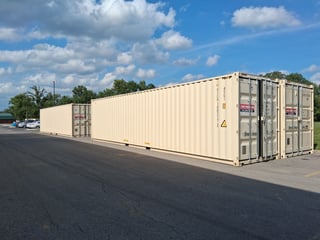
Need room for tools, school supplies, business inventory, or materials for a project? A 20ft storage container may be enough for a defined list of items. A 40ft container offers more length, but it also needs more room on-site and a workable delivery path.
The right choice depends on what you need to store, how you’ll get to it, and where the container can go. Here’s how to compare the two sizes before requesting a quote.
20ft vs. 40ft containers at a glance
|
Typical standard container |
20ft |
40ft |
|---|---|---|
|
Exterior dimensions (L × W × H) |
About 20′ × 8′ × 8′6″ |
About 40′ × 8′ × 8′6″ |
|
Approx. interior floor area |
150 sq. ft. |
300 sq. ft. |
|
Approx. interior volume |
1,170 cu. ft. |
2,390 cu. ft. |
A standard 40ft container is twice as long as a 20ft container, with about twice the floor area and a little more than twice the interior volume. These are typical measurements; exact dimensions and usable space vary by unit.
Start with what you need to store
Make a list of the items you plan to put inside, then measure the largest or most awkward ones. Exterior dimensions are useful for planning the site, but they don’t tell you what will fit through the doors or how much room you’ll have inside.
Leave space for shelves, pallets, walkways, and items you need to reach regularly. A full container may hold a lot, but if the supplies you use every day are buried at the back, it may not work well for your team.
When a 20ft container may be enough
A 20ft unit is worth considering when you have a defined storage list or want to preserve space around your property. It can work for contractor tools, seasonal business supplies, school event equipment, church furnishings, or household items during a project.
Before choosing this size, note anything that can’t be stacked and leave room to reach items near the back. Your inventory may be smaller than you think, but bulky pieces can take up more room than a simple item count suggests.
When to consider a 40ft container
A 40ft unit can suit a larger inventory or long materials that are difficult to store in a shorter container. It may also give a business, facilities team, or construction crew room to keep related supplies together as needs change.
Compare your longest items with the specific unit’s interior length and door opening. Don’t assume that an item will fit based on the container’s advertised exterior length alone.
Check the site and delivery route
A container needs room for both its footprint and delivery. Measure the intended placement area and then check for:
- Gate widths, tight turns, slopes, and obstacles along the route.
- Overhead branches, wires, or nearby structures for the delivery team to assess.
- Ground conditions and uneven areas at the placement location.
- Room to open the doors and move large items in and out.
- Ongoing access for people, vehicles, and equipment after placement.
Don’t use the container’s length as the delivery-clearance requirement. Truck space and unloading needs depend on the address, site layout, and delivery method.
Choose a door layout that works for your storage plan
Container length affects how much room you have. Door placement affects how easily you can use it.
- Standard: Cargo doors on one short end.
- Double-door: Cargo doors on both short ends, which may make it easier to access items from either end.
- Side-load: Doors on one short end and along one long side.
Our storage container primer explains these layouts and container grades. Ask JMO which configurations are currently available in your preferred size and how the door layout affects the quote. Not every size, grade, and door combination will necessarily be available.
Compare the full cost
A 40ft container will generally cost more than a 20ft one, but not necessarily twice as much. To compare floor-space value, use the same quote assumptions for both sizes:
Delivered cost ÷ usable floor area = cost per square foot
Cost per square foot is one useful comparison, not the whole decision. The 40ft unit may offer more space for the price, but that doesn’t help if it won’t fit your site or you don’t need the extra capacity. A 20ft unit that fills up quickly may lead to a second delivery or another container later.
Ask for an itemized quote and confirm what it includes:
- Container size, grade, door configuration, and purchase price or lease rate.
- Delivery and, for a lease, removal.
- Taxes and any applicable permit fees.
- Site preparation and delivery charges based on your location.
- The lease term, minimum commitment, and costs if you need the container longer.
Should you buy or lease?
Buying may make sense if you expect to use the container over the long term. Leasing may suit a project with a defined end date or a seasonal need. Compare the purchase price with the total lease cost over the period you expect to need storage, including delivery and removal.
JMO offers storage containers for purchase or lease. View JMO’s storage container options and ask for pricing based on your location, preferred size, and expected duration.
Frequently asked questions
Does a 40ft container hold exactly twice as much as a 20ft container?
Not exactly. A 40ft container has about twice the floor area, but the interior volume is a little more than twice that of a standard 20ft unit. Usable capacity depends on the specific unit, its door opening, and how you arrange the contents.
How much floor space do 20ft and 40ft containers provide?
Typical standard units provide about 150 square feet for a 20ft container and about 300 square feet for a 40ft container. Confirm the measurements for the specific unit you’re considering.
Are double-door and side-load containers available in both sizes?
Availability can vary. Ask JMO about the size, grade, and door layout you want so the quote reflects the configuration you need.
Can schools, businesses, and homeowners use the same sizing process?
Yes. Start with an inventory, measure oversized items, and check placement and delivery access. The contents differ, but the same questions help you compare container sizes.
Request a quote that fits your site
Measure the items you need to store, note your preferred door layout, and check the delivery route. Then ask JMO for an itemized quote that includes the container, delivery, and any lease or removal costs.
Request a quote from JMO with your delivery address, preferred size, storage needs, and purchase or lease preference. Include any site-access concerns so the team can review them with you.